People come to modern witchcraft from completely different directions. Some arrive through ritual magic, others through folk practice, herbalism, or a slow pull toward something they can’t quite name. What surprises most of them is how much variation exists once they get past the surface — and how little of what they expected actually matches what they find.
That’s not a flaw. It’s probably the most honest thing about this path.
Modern witchcraft is not one fixed system. It never has been. It’s a living body of practice that has survived suppression, cultural shifts, and centuries of misrepresentation to arrive at what it is today wider, more accessible, and more diverse than at any point in its history. Understanding it properly means letting go of the idea that there’s one correct version.
What Modern Witchcraft Actually Is
The simplest definition — and still one of the most accurate — is that witchcraft is the practice of working with natural and unseen forces to create intentional change. Aleister Crowley framed magick as the art and science of causing change to occur in conformity with will. That’s a useful starting point, even if it doesn’t capture everything.
What distinguishes modern witchcraft from its historical roots isn’t the core intent — that’s remained consistent. What’s changed is how openly it’s practiced, who has access to it, and how many different forms it now takes. The mid-20th century saw a small, largely secretive practice. What exists today is genuinely something else.
For some practitioners, witchcraft is purely practical — a set of ritual techniques applied with clear intention. For others it carries deep spiritual weight, involving deity relationships, seasonal observance, and a complete cosmological framework. Both approaches are legitimate. Neither cancels the other out.
The Role of Magic and Ritual in Modern Practice
● Spellwork and Intention
Magic in modern witchcraft runs from highly structured ceremonial systems to intuitive folk approaches, but the core idea stays consistent across all of them — focused intention directed toward a specific outcome. The tools, timing, and method support that intention. They don’t replace it.
Herbs, candles, oils, sigils, written workings, spoken incantations — these are vehicles. What drives the working is the clarity and strength of the practitioner’s will behind it. This is something I’ve seen people misunderstand repeatedly when they’re starting out. They focus on getting the tools right and underestimate the internal work.
Ritual magic — the more structured end of the spectrum — brings in ceremonial frameworks, specific correspondences, and often invocation of specific forces or entities. It requires more preparation and more precision. The results, when the work is done properly, tend to be more defined.
● Tools of the Practice
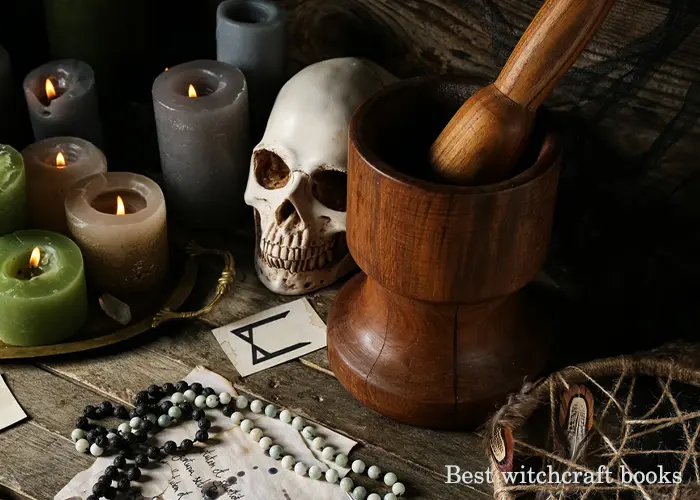
Tools serve as focal points for energy during ritual work. The athame — a ritual blade, typically double-edged — is used in many traditions to direct energy rather than cut physically. Wands serve a similar directional purpose and can be made from wood, crystal, or metal depending on the practitioner’s preference.
The cauldron appears consistently across traditions as a vessel for transformation — in ritual, in spellwork, and symbolically. Beyond these core tools, what a practitioner keeps on their altar varies enormously. Some work with minimal tools. Others build elaborate working spaces. Neither approach is more valid than the other.
What matters is that the tools are chosen with intention and used with understanding. A well-chosen book, for that matter, functions as a tool — especially early in a practice, when foundational knowledge shapes everything that follows.
Spiritual Dimensions — Deities, the Moon, and the Wheel of the Year
● Working With Deities
Most modern witchcraft traditions take a theistic approach, though what that looks like varies. The most common framework in neopagan witchcraft pairs a god and goddess — sometimes with the goddess as primary — as the central focus of spiritual practice. These deities are called on in ritual, honored through observance, and often directly involved in magical workings.
Some practitioners work with a single deity. Others draw from a specific pantheon while remaining flexible about which figures they call on depending on the working. Others take an entirely non-theistic approach, treating magical forces as natural rather than personal.
None of these is the wrong answer. This is one of the places where modern witchcraft genuinely differs from more rigid religious structures — the practitioner’s relationship with the divine is self-defined.
● The Wheel of the Year
Many modern witches mark eight seasonal holidays spaced roughly six weeks apart — four based on solar positions and four drawn from older fire festival traditions. Samhain in late October, Yule at the winter solstice, Imbolc in early February, Ostara at the spring equinox, Beltane on the first of May, Litha at midsummer, Lughnasadh in early August, and Mabon at the autumn equinox.
These aren’t arbitrary dates. They map the natural cycle of the year — the balance of light and dark, the rhythms of growth and decay. Working in alignment with these cycles is one of the ways modern witchcraft stays rooted in something older and larger than individual practice.
Alongside the solar calendar, most practitioners mark the lunar cycle — particularly the full moon, which is considered favorable timing for workings related to manifestation, empowerment, and charging tools.
Modern Witchcraft and Community
Historically, many practitioners worked alone. Solitary practice is still common and entirely valid. But modern witchcraft has developed a genuinely global community in a way that simply wasn’t possible before.
Online spaces — forums, social media groups, video platforms — have connected practitioners across geography and demographic in ways that changed the landscape entirely. Someone in a rural area with no local community can now access teaching, discussion, and shared practice with people across the world.
This has also accelerated the growth of the practice significantly. Access to information, once limited to what was available in local bookshops or through personal connections, is now essentially unlimited. The responsibility that comes with that is knowing how to evaluate what you’re reading — which is exactly why foundational texts from serious practitioners matter more than ever.
Where Occultism and Modern Practice Meet
Modern witchcraft doesn’t exist in isolation from the broader history of occultism. Ceremonial magic traditions, Hermeticism, Kabbalah, folk magic lineages from multiple cultures — these have all contributed to the body of practice that modern witches draw from.
Understanding that history changes how you practice. It gives context to the tools, the symbols, the ritual structures. It explains why certain approaches produce certain results. Practitioners who study seriously — who go beyond the introductory level into the actual source material and serious modern commentary — develop a noticeably different quality of practice.
Occultism as a wider field rewards depth. And the depth is in the books.
Frequently Asked Questions
What is the difference between witchcraft and magick?
The spelling “magick” — with a k — was popularized by Aleister Crowley to distinguish intentional occult practice from stage illusion. In modern use, magick often refers specifically to ceremonial or ritual approaches, while witchcraft carries a broader meaning that includes folk practice, nature-based spirituality, and diverse ritual traditions. Many practitioners use both terms interchangeably.
Do you have to follow a specific tradition to practice modern witchcraft?
No. Modern witchcraft is notable for its flexibility. Some practitioners choose to work within a defined tradition with specific structure and lineage. Others build a practice that’s entirely personal, drawing from multiple sources and adapting over time. Both approaches are legitimate, and most serious practitioners evolve their practice significantly as their knowledge grows.
check this guide also to learn about the different types of witchcraft
What is the Wheel of the Year?
The Wheel of the Year is a calendar of eight seasonal celebrations used widely in modern neopagan witchcraft. Four are based on solar events — the solstices and equinoxes — and four derive from older Celtic fire festival traditions. Together they mark the full annual cycle of growth, decay, and renewal that modern witchcraft aligns itself with.
Is modern witchcraft a religion or a practice?
Both, depending on who you ask — and that’s a genuine answer, not an evasion. For some practitioners, witchcraft carries full religious weight with deity relationships, spiritual community, and doctrinal beliefs. For others it’s a practical system of working with natural forces, with no religious component at all. Modern witchcraft accommodates both perspectives within the same broader community.
Where should someone start learning about modern witchcraft seriously?
Start with foundational texts written by practitioners with real depth — not trend-driven introductions, but books that go into the actual mechanics of ritual magic, the history of the practice, and the philosophical frameworks behind it. A modern guide to witchcraft that covers both the theory and the practical application is worth far more than a dozen surface-level reads.
Ready to Build a Real Practice?
Modern witchcraft rewards serious study. The practitioners who get real results — whose ritual work is consistent, whose understanding runs deep — are the ones who invested in learning from serious sources rather than staying at the surface.
If you’re ready to go beyond the basics, our collection is built around exactly that. We carry foundational grimoires, serious modern practitioner guides, and books that cover ritual magic, occultism, folk practice, and the broader history of the craft in genuine depth.
Looking for a place to start? Our *Modern Guide to Witchcraft* is one of the most complete introductions available — covering practice, philosophy, and the real mechanics behind the work.
And if you want to explore the full range of what we carry:
check our complete witchcraft books collection
The Path Is Yours to Define
Modern witchcraft doesn’t hand you a fixed map. It gives you a set of principles, a body of accumulated knowledge, and a living community — and then it asks you to find your own way through it.
That process takes time. It takes reading, practice, reflection, and a willingness to revise what you think you know as you learn more. The practitioners who stick with it describe the same thing consistently — a deepening sense of connection to something real, something that responds, something that grows alongside them.
The knowledge is there. The question is how seriously you want to pursue it.